
Supporting Independent Living with Dementia: The Role of Assistive Technology

Technology can help people living with dementia maintain independence, confidence and connection. As conversational AI and intelligent monitoring evolve, the opportunity is growing, but so is the importance of selecting technology that adapts to individual needs.

A Day in Eddy's Life
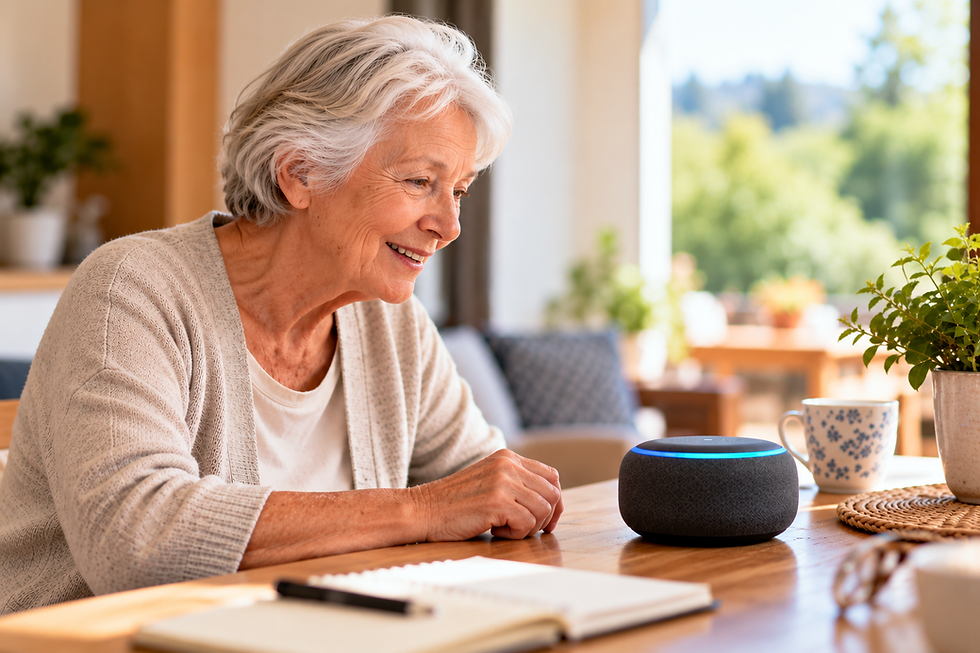
At 6:30 in the morning, the alarm sounds. Eddy gets up, walks into the living room and asks his voice assistant what day it is. He receives a simple answer: it is Friday, and the weather forecast suggests he might need a jacket if he goes outside.
For most people, these interactions seem unremarkable. For Eddy, they provide useful orientation and reassurance at the beginning of his day.
Eddy is 63 and has taken early retirement from his accounting career following a diagnosis of early-stage dementia. He lives with his wife, Marci, who wants to continue working while supporting his wish to remain independent for as long as possible.
This illustrative scenario, first explored by eHomeCare in 2018, highlights an important opportunity for assistive technology. The objective is not simply to automate everyday activities. It is to help people retain confidence, autonomy and connection as their circumstances change.
Independence Is More Than Living Alone
Independent living is often associated with remaining in one's own home. For someone living with dementia, however, independence has a broader meaning. It includes making decisions, maintaining familiar routines, communicating with others and participating in everyday activities.
Dementia affects individuals differently. Changes in memory, orientation, communication and judgement may develop gradually, and capabilities can vary considerably between people.
Technology that supports one individual may be confusing or unsuitable for another. The starting point should therefore be an understanding of the person's abilities, preferences, environment and support arrangements rather than a particular device or application.
The most useful technologies are often those that compensate for a specific difficulty without unnecessarily taking control away from the individual.
Supporting Orientation and Daily Routines
For Eddy, asking a voice assistant about the date or weather is a simple way to obtain information without navigating a smartphone or computer. Similar technology can provide reminders about appointments, meals, medication and everyday activities.
Digital calendars, automated prompts and connected devices may help people maintain familiar routines and reduce their reliance on family members for repetitive information.
However, there is an important distinction between providing a reminder and ensuring that the intended activity has occurred. A voice assistant may announce that medication is due, but it cannot necessarily establish whether the correct medication has been taken.
Likewise, a reminder to attend an appointment is only useful if the person understands the instruction and can act on it.
Providers should therefore consider how reminders fit within broader care arrangements, including when follow-up or additional support is necessary. As dementia progresses, instructions may need to become simpler, and previously useful technologies may require adjustment.
Creating a Safer Home Environment
Another opportunity lies in technologies that monitor aspects of the home environment and identify situations requiring attention.
In the original Eddy and Marci scenario, a temperature sensor could identify when the living room became excessively hot and prompt Eddy to take appropriate action.
Connected home technologies can potentially combine environmental information with automated alerts and monitoring services. Examples include unusual indoor temperatures, smoke detection, doors left open or changes in everyday activity patterns.
These technologies may help identify emerging risks without requiring continuous direct supervision.
However, detecting an unusual condition is not the same as understanding its significance. A lack of movement might indicate that someone is resting, has left home or requires assistance.
The system needs appropriate context, and someone must be responsible for interpreting and responding to alerts.
This is particularly important when technology supports people who may have difficulty recognising or communicating their needs.
For more on the different approaches to monitoring, see What Is Remote Monitoring?.
Emergency Assistance Must Be Reliable
Marci remembers an occasion when Eddy experienced severe lower-back pain and struggled to get out of bed. Knowing that he can request assistance provides reassurance, particularly when she is away from home.
Voice-activated emergency systems may offer an accessible alternative to wearable buttons or other physical controls.
However, voice should not automatically be considered a reliable replacement for established emergency assistance arrangements.
A person experiencing a fall, medical emergency or acute confusion may be unable to speak clearly or remember the required command. Background noise, connectivity problems and speech-recognition limitations can also interfere with activation.
Where voice technology is incorporated into an emergency monitoring service, providers should understand how alerts are received, who responds, what escalation arrangements apply and how failures are managed.
For individuals at higher risk, multiple ways of requesting assistance may be necessary.
The objective should be a dependable response system, not simply an easier way to initiate a call.
Conversational AI: A New Dimension of Support
Since eHomeCare first explored Eddy's situation, voice technology has evolved considerably.
Traditional voice assistants generally relied on predefined commands and structured interactions. Newer conversational AI systems can respond to more complex questions, maintain conversational context and adapt their responses to the interaction.
For people living with dementia, this creates opportunities beyond simple reminders.
An AI assistant might help someone work through a familiar routine, explain information in simpler language or provide conversational guidance when a task becomes confusing.
It may also support family members by helping organise information, prepare questions for care professionals or identify matters requiring follow-up.
However, natural conversation does not guarantee reliable information.
Generative AI can misunderstand questions, provide incorrect answers or respond inconsistently. A person experiencing cognitive difficulties may be less able to recognise these errors or challenge an apparently authoritative response.
There is also a difference between providing conversational support and delivering clinical advice. AI should not independently interpret symptoms, recommend medication changes or make consequential care decisions without appropriate clinical safeguards.
The opportunities and risks of these technologies are explored further in Voice Assistants and Conversational AI in Aged Care: Five Applications and Their Risks.
AI Companionship and Human Connection
Conversational AI may also offer opportunities to address loneliness and support everyday engagement.
An AI assistant could initiate conversations, encourage participation in activities or help someone reconnect with familiar interests.
For people who spend considerable time alone, these interactions may provide stimulation and a sense of routine.
However, AI companionship raises important ethical and practical questions.
A system that appears empathetic may encourage emotional attachment despite having no genuine understanding of the person's circumstances. It may also produce misleading information or reinforce confusion.
For someone living with dementia, providers must consider whether the interaction supports wellbeing or introduces additional uncertainty.
AI companionship should complement, rather than replace, relationships with family, friends and care professionals.
The appropriate measure of success is not how long someone interacts with an AI system, but whether it contributes positively to their wellbeing, confidence and meaningful social connection.
Supporting Families Without Creating Constant Surveillance
Technology can provide reassurance to family members and informal carers.
Marci does not necessarily need continuous information about everything Eddy does throughout the day. She may simply want confidence that he is maintaining his normal routines and that significant changes or emergencies will receive attention.
A monitoring system that generates excessive notifications can increase anxiety and create unnecessary work. Conversely, a system that suppresses too many alerts may fail to identify meaningful concerns.
The most appropriate arrangement balances useful information with privacy, independence and individual preferences.
For people living with dementia, consent and decision-making capacity require particular attention. Capacity should not be assumed absent simply because someone has received a dementia diagnosis.
Individuals should remain involved in decisions about technology wherever possible, with appropriate support as their circumstances change.
Providers must also consider who can access monitoring information, how it is used and whether the level of monitoring remains proportionate to the person's needs.
Looking Ahead: Dementia Care Technology, 2026–2028
The next three years are likely to bring further changes in how assistive technology supports people living with dementia.
Rather than predicting precise adoption rates, eHomeCare sees three developments that aged care providers should prepare for.
2026 — More capable conversational assistance
Conversational AI is expanding the capabilities of voice-enabled systems beyond simple commands and reminders.
The immediate opportunity lies in accessible information, personalised prompts and assistance with everyday routines. However, providers will need to distinguish demonstrated capabilities from supplier claims, particularly where reliability and safety are concerned.
2027 — Greater integration of voice, monitoring and care services
A likely direction is closer integration between conversational interfaces, environmental sensors, activity monitoring and care management systems.
Rather than operating as isolated devices, technologies may increasingly contribute to a coordinated understanding of a person's needs.
For example, changes in activity patterns could prompt a care team to review whether additional support is required.
The challenge will be ensuring that information is interpreted appropriately and leads to meaningful action rather than simply generating more alerts.
2028 — More personalised and adaptive support
Looking further ahead, AI may increasingly support interactions that adapt to an individual's changing abilities and preferences.
This could include simpler instructions, personalised routines and more responsive communication.
However, adaptation introduces questions about how systems recognise changes, how recommendations are validated and who remains accountable for decisions.
Providers should expect the importance of governance, clinical assurance, privacy and human oversight to increase alongside technological capability.
These are directional expectations rather than guaranteed milestones. Adoption will depend on affordability, evidence, regulation, workforce capability and the willingness of individuals and providers to use these technologies.
Technology Must Adapt as Needs Change
One of the greatest challenges in supporting people living with dementia is that their needs and capabilities may change over time.
A solution that works well today may become difficult to use later. Someone who initially benefits from spoken reminders may eventually struggle to understand them.
A monitoring arrangement that once provided reassurance may require additional safeguards as risks increase.
This makes ongoing assessment essential.
Providers should consider whether technology remains appropriate, whether the individual can still use it effectively and whether family members or care teams need additional support.
Technology selection should also account for installation, maintenance, connectivity, training and the responsibilities of different parties.
These considerations reflect the wider challenges of technology adoption explored in Why Care Technology Adoption Fails: Seven Influences Every Provider Should Understand.
A technically capable solution does not necessarily translate into sustainable care outcomes.
Preserving Independence, Not Replacing Care
For Eddy and Marci, the value of technology is not measured by the number of connected devices in their home.
It is measured by whether Eddy can continue doing the things that matter to him while Marci maintains confidence in the support arrangements around him.
Technology may help people living with dementia remain independent for longer, but it cannot eliminate every risk or replace the relationships and professional judgement essential to good care.
For aged care providers, the challenge is to select and integrate technologies that reflect individual needs, complement existing services and remain appropriate as circumstances change.
Through Technology Advisory, eHomeCare helps providers evaluate assistive technologies against care objectives, operational requirements and the needs of the people they support.
The goal is not to make people dependent on technology. It is to use technology thoughtfully to preserve independence, dignity and quality of life for as long as possible.
Hubert van Dalen is the founder of eHomeCare, providing independent digital strategy, governance, technology and transformation advisory services to Australian aged care and disability providers.


Comments